
Virtual Reality Exposure Therapy in Las Vegas: What It Is and How to Start
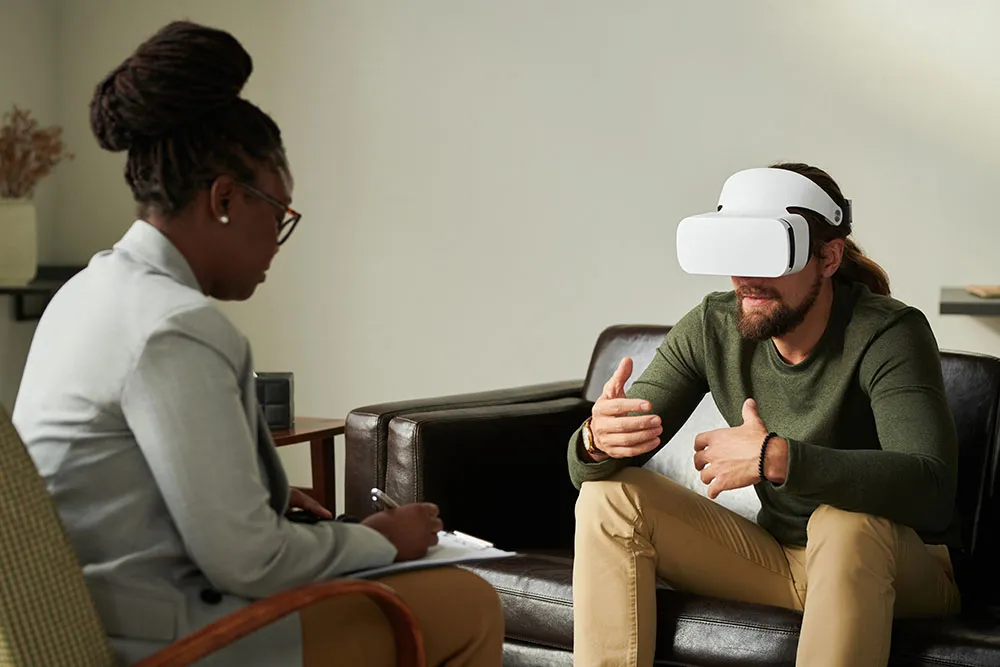
Virtual reality exposure therapy (VRET) is a form of exposure therapy in which you wear a headset and face a feared situation in a virtual environment, guided by a clinician who controls the intensity. At Family Trauma Treatment Center in Las Vegas, it is offered in person as a way to build confidence with phobias, anxiety and trauma triggers at a pace you can manage. This article explains how it works, who may benefit, and what to expect if you decide to ask about it.
What virtual reality exposure therapy is
The short answer: guided, gradual practice facing a fear, using a headset instead of real-world exposure.
Exposure therapy is built on a simple idea: instead of avoiding something that frightens you, you approach it gradually, with support, at a pace you agree on.
VRET uses a headset to place you in a virtual environment tied to your specific fear. Our virtual reality therapy page describes it as a safe, guided way to face fears with no real-world exposure required to start. That can matter if the real situation is hard to arrange, costly or simply too overwhelming as a first step.
Who may want to ask about it
The short answer: people whose fear or triggers keep them avoiding parts of life.
Our site lists these concerns for VRET:
- Phobias
- Panic disorder
- Social anxiety
- OCD
- PTSD
- Generalized anxiety
You do not need a diagnosis to ask. If a situation is shrinking your life, such as avoiding driving, crowds, public speaking, medical settings or reminders of something painful, that is reason enough to talk to a clinician. Many people wait a long time before asking because they worry their fear is not serious enough. It is fine to ask anyway.
VRET is not the right fit for everyone. Some people do better starting with talk-based counseling, and a clinician can help you decide whether VR belongs in your plan now, later or not at all.
What a VRET session can look like
The short answer: a private room, a headset, and a clinician who sees what you see.
Our site describes a private, dark room and a headset that immerses you in an environment connected to your fear. Your therapist watches the same scene you do and controls the intensity, length and pacing, so nothing moves faster than you are ready for. All equipment is provided in the office.
In general, exposure work follows a rough shape, though your clinician will tailor it to you:
- Talking first. You and your clinician discuss what you want to change and what feels manageable.
- Preparing. You review how the session works and agree on how you will signal if you need to slow down.
- Gradual exposure. The scene is introduced at a level you can tolerate, then adjusted over time.
- Debriefing. You talk through what came up and what you noticed in your body and thoughts.
Because the environment is virtual, the clinician can pause, repeat or dial things back in a way that is hard to do in real life.
How it fits with other care
The short answer: VRET is usually one piece of a broader plan.
Our site describes a range of approaches, including individual counseling, group counseling, Forward-Facing Trauma Therapy and others, and says a plan might use one approach or several and can change over time. If trauma is part of what brings you in, our guide to PTSD treatment in Las Vegas compares the options and explains how to choose a starting point.
Some people use VR practice to build skills and confidence, and then work on applying them in daily life with their clinician’s support. Others find that counseling alone is the better path. There is no single right route, and honest advice from a clinician should include that.
Why some people prefer a virtual setting
The short answer: it can make a first step feel more possible.
Facing a fear in real life can mean booking a flight, standing in a crowd or returning to a place tied to something painful. For many people that is simply too big a first step, so they keep putting it off. A virtual environment lets the work start in a controlled room, with a clinician beside you, before any real-world step is attempted.
It can also make practice easier to repeat. A clinician can return to the same scene as often as is useful and adjust it each time, which is hard to arrange outside the office. Some people also find it easier to talk about a fear once they have seen it in a setting they are in control of. None of this makes VRET easy, and it can still bring up strong feelings. The goal is to keep those feelings within a range you can work with, which is why pacing matters so much.
Common worries about VR therapy
The short answer: most concerns can be raised before the first session.
- “I will feel out of control.” Your clinician sees what you see and sets the pace, and you can ask to slow down or stop.
- “I am not good with technology.” You do not need to be. The equipment is provided and set up for you.
- “What if it makes me feel worse?” Strong feelings during exposure work can be part of the process, and a clinician helps you stay regulated. If something feels like too much, say so.
- “Is this a replacement for counseling?” Not necessarily. For many people it sits alongside other work.
What this looks like at FTTC
The short answer: in-person care, a licensed clinician, and a plan built with you.
We are at 3909 South Maryland Parkway, Suite 405, Las Vegas, NV 89119. Sessions are in person, and are usually 45–55 minutes and usually weekly, though your clinician will talk through what to expect for your situation. VR therapy is one of the services we offer alongside individual counseling, group counseling, cognitive behavioral therapy and other approaches.
Questions worth asking at your first conversation:
- Is VR exposure therapy a reasonable fit for my specific fear or triggers?
- How will we decide the pace, and how can I ask to slow down?
- How would VR sessions fit with any other counseling I am doing?
- What should I do before and after a session if I feel shaky or tired?
Questions to think about before you call
The short answer: a few honest notes can make the first conversation easier.
You do not need a polished explanation. It can help to jot down what you avoid, when the fear started to affect your day, what you have already tried, and what you would like to be able to do again. If you have a medical condition that could be affected by a headset, such as dizziness, seizures or motion sensitivity, mention it so your clinician can take it into account. This article does not replace that conversation, and only a licensed clinician can tell you whether VR exposure is appropriate for you.
Ask about virtual reality exposure therapy
If you are curious about virtual reality exposure therapy in Las Vegas, we are glad to talk it through, with no pressure to commit. Call (702) 485-1313 or request an appointment. You can also read more about virtual reality therapy at FTTC.
Hours: Monday–Friday 8:00 am–7:00 pm, Saturday 9:00 am–3:00 pm, Sunday by appointment only.
This article is educational and does not replace evaluation by a licensed professional.
In crisis? Call or text 988. Emergency: call 911.
Is virtual reality exposure therapy safe?
Our site says a licensed clinician controls the pace and intensity in real time, so the experience is guided rather than left to chance. You can talk about how you are feeling throughout. Whether it is a good fit for you is a decision to make with a clinician who knows your history, so ask before you begin.
Do I need to bring my own VR equipment?
No. All equipment is provided in our office. You do not need to buy a headset or install anything. Sessions take place in person at our Las Vegas location, so the main thing to bring is yourself and any questions you have about how the work will unfold.
What conditions can VR exposure therapy be used for?
Our virtual reality therapy page lists phobias, panic disorder, social anxiety, OCD, PTSD and generalized anxiety. It is not the right tool for every person or every concern, so a clinician will talk with you about your goals and whether this approach makes sense before suggesting it.
Will I be pushed to face my fear too fast?
That is not how it is meant to work. Your therapist sees what you see and adjusts intensity, length and pacing, so nothing moves faster than you are ready for. Many people find it reassuring to know the clinician can slow down or change course at any point during the session.
Can I combine VR therapy with other treatment?
Often, yes. Our site describes plans that can include individual counseling, group counseling and other approaches, and it says plans can change as you do. If you are already working with a clinician, mention your interest in VR so your care stays coordinated.