VR Therapy for PTSD: How It Works and What to Expect

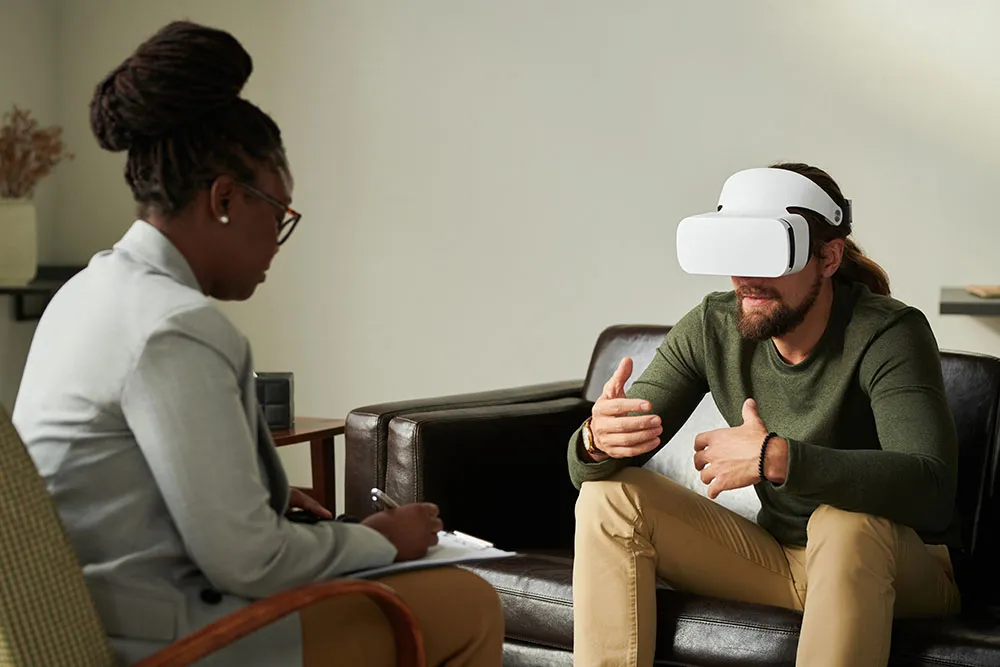
How does VR therapy for PTSD work? A licensed clinician places you in a virtual environment connected to a fear or trigger, controls how intense and how long each exposure is, and helps you practice staying with the feeling at a pace you can handle. It is a form of exposure therapy, delivered with a headset instead of real-world situations. At Family Trauma Treatment Center in Las Vegas, our virtual reality therapy lists PTSD among the conditions it can help with.
If you have been curious but unsure what a session involves, this guide explains the method in plain language, what it feels like, who may be a good fit, and when another approach might make more sense. It is meant to help you prepare for a conversation with a clinician, not to diagnose or replace one.
What is exposure therapy for PTSD?
The short answer: exposure therapy means gradually facing reminders of a frightening experience, with support, at a pace you and your clinician agree on.
After trauma, many people avoid anything that reminds them of what happened. Avoiding feels protective in the moment, but it can make triggers feel bigger and shrink your world over time. Exposure therapy works in the opposite direction. With support, you approach reminders in small, planned steps, and you practice staying with the discomfort, with support.
Exposure does not mean reliving everything at once. It is paced, and it is something you and your clinician decide on together.
How does VR therapy for PTSD work?
The short answer: the headset creates a controlled version of a situation, and your therapist adjusts it in real time.
Traditional exposure can rely on imagining a memory or visiting a real place. Some situations are hard to imagine clearly, and others are hard or impractical to visit. Virtual reality exposure therapy, often shortened to VRET, offers a middle path. Our site describes a private, dark room and a headset that immerses you in an environment tied to your specific fear.
The key features, as our site describes them:
- Your therapist sees what you see. The clinician is following along, not guessing how you are doing.
- The clinician controls intensity, length and pacing. Nothing moves faster than you are ready for.
- No real-world exposure is required to start. You can begin practicing in a controlled space.
- Equipment is provided in the office. You do not bring or buy anything.
Because the environment is controlled, it can be repeated, slowed down or stopped. That predictability is one reason people who feel nervous about exposure sometimes find a virtual setting a gentler way to begin.
What does a VR therapy session feel like?
The short answer: a conversation first, then guided practice, then time to talk about what came up.
Every person is different, and your clinician shapes the plan around you. In general, you can expect something like this:
- A conversation about your goals. Before any headset, your clinician learns about your history, your symptoms and what you want to change.
- A plan for what you will face and in what order. Starting points are agreed together, and you can say what feels too much.
- Guided time in the virtual environment. You may notice a racing heart, tension or strong emotion. Those reactions are expected, and your clinician helps you work with them.
- Time to talk afterward. You and your clinician discuss what happened, what helped and what to adjust next time.
Sessions at FTTC are usually 45 to 55 minutes and usually weekly. If something feels like too much, say so. You are always allowed to pause.
Who might VR therapy be a good fit for?
The short answer: people for whom specific triggers or avoided situations are a big part of the picture.
Our site lists PTSD alongside phobias, panic disorder, social anxiety, OCD and generalized anxiety as conditions VRET can help with. VR may be worth asking about if:
- Particular places, sounds or situations set off strong reactions
- You have been avoiding things you used to do because of fear
- Talking about your experience has helped, but triggers still get in the way
- You are curious about a more structured, practice-based approach
Some people are not ready for exposure work yet. If you are in a period of crisis, feel unsafe, or need to build coping skills first, a clinician may suggest starting with individual counseling or Forward-Facing Trauma Therapy, a present-focused practice combining CBT and brain science. Starting somewhere else is not a setback. It is often a sensible way to prepare.
How VR therapy compares with other PTSD options
The short answer: no single option is right for everyone, and they are often combined.
| Approach | What it offers | May suit you if |
|---|---|---|
| Individual counseling | A steady place to talk with a licensed clinician | You want to start by building trust and understanding |
| Forward-Facing Trauma Therapy | Practical, present-focused self-regulation skills | You want tools to stay grounded under stress |
| Virtual reality therapy | Clinician-controlled exposure to triggers | Specific triggers are central to your experience |
For a wider look at how these fit together, see our guide to PTSD treatment in Las Vegas. Be cautious about any provider who promises a particular outcome. Responses to therapy vary, and an honest clinician will talk about what to expect rather than guarantee results.
What this looks like at FTTC
The short answer: in-person, clinician-led care in a private room, with equipment provided.
Family Trauma Treatment Center is an outpatient trauma and mental health practice at 3909 South Maryland Parkway, Suite 405, Las Vegas, NV 89119. Virtual reality exposure therapy is one of the services we offer, alongside individual counseling, group counseling, Forward-Facing Trauma Therapy and device-based options. A licensed clinician guides every session and controls the pace in real time. You are never expected to go faster than you are ready for.
If you are not sure whether VR is right for you, you do not have to decide before you call. A first conversation is a chance to ask questions and talk through options.
Questions to ask before you start
A few questions can help you feel more in control:
- How will you pace the exposure, and how do I tell you to slow down or stop?
- What would we do if a session feels like too much?
- Would you suggest VR on its own, or alongside counseling?
- What should I do if I get motion-sick or uncomfortable in a headset?
- How will we know whether it is helping?
Book a consultation
If you would like to talk about whether VR therapy fits your situation, we are here to help. Call us at (702) 485-1313 (Mon–Fri 8:00 am–7:00 pm, Sat 9:00 am–3:00 pm, Sun by appointment only) or request an appointment online. You can read more about virtual reality therapy at FTTC first if you prefer.
This article is educational and does not replace evaluation by a licensed professional.
In crisis? Call or text 988. Emergency: call 911.
Is VR therapy for PTSD safe?
Our virtual reality therapy page says a licensed clinician controls the pace and intensity in real time, and your therapist sees what you see. That structure is a large part of how the approach is kept manageable. Still, exposure work can bring up strong feelings, so tell your clinician about any concerns, including motion sensitivity, before you begin.
Do I need to bring my own VR equipment?
No. According to our site, all equipment is provided in the office, so there is nothing to buy, set up or bring. You attend in person at our Las Vegas location, where sessions take place in a private room with a headset and a clinician beside you throughout.
Is VR exposure therapy the same as just facing my fears?
No. Facing fears on your own can feel overwhelming and unplanned. In VR exposure therapy, a clinician builds a plan with you, controls intensity, length and pacing, and pauses when needed. The goal is steady, supported practice, with no pressure to move faster than you are ready for.
Will VR therapy replace talking therapy for PTSD?
Not necessarily. Many people use virtual reality therapy alongside counseling or other approaches, and a clinician helps decide what combination fits. For some people a different starting point, such as individual counseling or Forward-Facing Trauma Therapy, is a better first step. An honest evaluation should say so.
How many VR therapy sessions will I need?
There is no single answer, and our site does not state a set number of VR sessions. Sessions at FTTC are usually 45 to 55 minutes and usually weekly. Your clinician can talk with you about a realistic plan after learning about your history, symptoms and goals.